 Tako Docs
Thiolate–CO₂ Adduct Formation
On this page
Physisorption or chemisorption
CO₂ is an unreactive molecule. It is linear, closed-shell, and unusually stable, and its one reactive site is a carbon left electron-poor by its two flanking oxygens. Hand that carbon a good nucleophile and it will react — but there are two very different outcomes. A soft sulfur anion can rest against the molecule, held by dispersion and electrostatics with no orbital overlap: physisorption, a loose contact that gentle warming reverses. Or the sulfur lone pair can add across a C=O, bending the linear molecule toward a carboxylate and forming a covalent S–C bond. That second outcome — chemisorption — is the molecular event behind “CO₂-philic” capture liquids and the task-specific ionic liquids built around anions engineered to bind CO₂ chemically rather than merely dissolve it. An anion that bonds holds CO₂ far more tightly than one held only by dispersion, and that difference makes or breaks a capture chemistry.
The question is concrete. Take benzyl thiolate, PhCH₂S⁻, a plain nucleophilic sulfur anion. Does it chemisorb CO₂ and form a real S–C bond — and if it does, how much energy does that release? It can be settled on a laptop. The workflow relaxes six small molecules and closes the cycle locally in a few minutes.
Turning “does it bind?” into one number
“Does it bind, and how hard?” becomes a single number the moment we write CO₂ addition as a balanced reaction and take the energy difference across it:
Three energies, one subtraction — which in the script is exactly what it looks like:
const bindingEv = adduct.energyEv - thiolate.energyEv - co2.energyEv;The atoms balance, C₈H₇O₂S⁻ = C₇H₇S⁻ + CO₂, and so does the charge: thiolate and adduct each carry −1, CO₂ is neutral. A negative result means the addition is exergonic on this scale — the adduct is lower in energy than the separated fragments. We relax each molecule with GFN2-D4 (the GFN2 tight-binding Hamiltonian plus a D4 dispersion correction), which is fast enough to make a six-molecule cycle a coffee-break calculation and accurate enough to tell a covalent bond from a van der Waals contact.
The charge balance carries the one point about the setup that is real chemistry rather than bookkeeping. Benzyl thiolate and the adduct are anions; CO₂ is neutral. A thiolate is not a thiyl radical — it is that sulfur plus one extra electron — and if we handed all three molecules to the same neutral calculator, two of them would be solved for the wrong number of electrons entirely. So the anions and the neutral get separate calculators, distinguished by a single line:
const gfn2Anion   = tako.calculator.gfn2({ levelOfTheory: 'gfn2', dispersion: 'd4', charge: -1 }); // the extra electron that makes it a thiolate
const gfn2Neutral = tako.calculator.gfn2({ levelOfTheory: 'gfn2', dispersion: 'd4', charge:  0 });
CO₂, benzyl mercaptan, and H₂S run neutral; benzyl thiolate, the adduct, and HS⁻ run as −1 anions. charge: -1 sets the total charge of the whole molecule, not a charge per atom — it is what makes the species a closed-shell anion rather than an open-shell radical, and getting it right is the difference between modeling this chemistry and modeling a different one.
When the cycle closes, the answer is unambiguous: the binding energy comes back large and negative — far beyond the few kJ mol⁻¹ a loose physisorbed contact could ever supply. On GFN2-D4’s gas-phase scale, benzyl thiolate chemisorbs CO₂.
Checking the geometry
A strongly negative energy is necessary but not sufficient. GFN2’s one realistic way to mislead us here is to let the freshly made S–C bond spring back apart during relaxation — the adduct decaying into a loose ion–molecule pair that would quietly report a physisorption energy while we call it chemisorption. The energy alone cannot tell those apart. The geometry can.
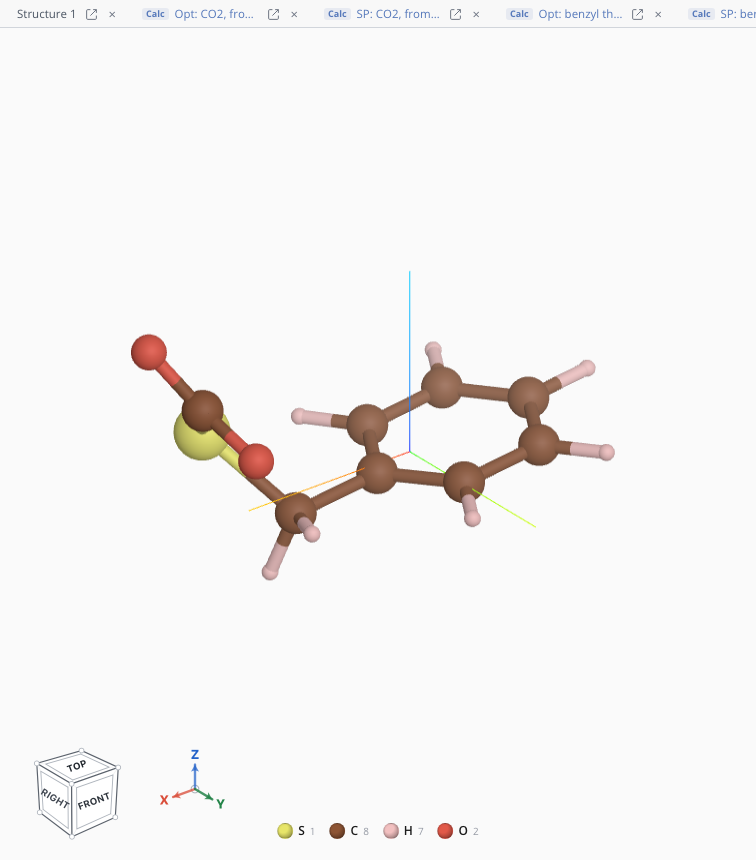
We examine the relaxed geometry. The adduct is seeded with an S–C distance of 1.800 Å — squarely in the range of a covalent monothiocarbonate — and after relaxation it stays there, near ~1.8 Å, nowhere near the ~2.5 Å where a merely physisorbed pair would have drifted. The sulfur has added across a C=O: the linear O=C=O has bent, one oxygen has become a carboxylate, and the product is a real PhCH₂–S–CO₂⁻ monothiocarbonate rather than a fleeting encounter complex. The negative energy and the surviving bond describe the same covalent addition.
Charge transfer onto CO₂
Energy and geometry are two views of the same bond. The electrons give a third, independent one. If the sulfur formed a covalent bond to carbon, negative charge should have spilled out of the anion and onto the CO₂-derived fragment — a partial monothiocarbonate carrying part of the −1. We sum the Mulliken charge on the three CO₂-derived atoms in the adduct and compare it to free CO₂:
A substantial parcel of electron density has moved onto the fragment — orders of magnitude larger than the ~10⁻³ e that is the floor for a molecule held only by dispersion. Charge transfer of that size is the electronic signature of bond formation, not a weak polarization. Mulliken populations are model-dependent, so we read this as a corroborating fingerprint rather than a measured electron count, but it points the same way as the energy and the bond length: this is a bond.
Competing protonation
The same six energies answer a second question at no extra cost. A thiolate does not sit alone in a capture liquid — it competes for protons. If an ambient weak acid such as H₂S can reprotonate the thiolate back to its mercaptan, the anion is neutralized before it ever meets CO₂. Whether that happens is a matter of relative S–H acidity, which a near-isodesmic exchange gets at directly:
const relativeSHAcidityEv = (rsh.energyEv + hsAnion.energyEv) - (thiolate.energyEv + h2s.energyEv);One anion and one neutral sit on each side, so most of GFN2’s minimal-basis bias in absolute anion energies cancels between reactants and products, and the sign of the result is meaningful even where the magnitude is not — provided it clears a ~15 kJ mol⁻¹ noise floor below which GFN2 cannot say which acid is stronger. This is a proxy for the competing protonation and nothing more: CO₂ never appears in the equation, so it says nothing about H₂S-versus-CO₂ capture selectivity.
What the number means
Three independent readings — a large negative binding energy, an intact ~1.8 Å S–C bond, and real charge on the CO₂ fragment — all say the same thing: benzyl thiolate chemisorbs CO₂, forming a covalent monothiocarbonate. That is a solid result, and it is the right kind of result: enough to confirm that this anion binds and to rank it against related anions.
One honest limit governs how far the number travels. This is a gas-phase 0 K electronic ΔE, and it runs roughly 40–100 kJ mol⁻¹ more exothermic than any solution-phase ΔG for the same reaction — everything pushes the same direction. Fusing two molecules into one costs association entropy, about +40 kJ mol⁻¹ of −TΔS at 298 K, which the gas-phase electronic energy omits entirely. And a solvent stabilizes the small, charge-localized reactant thiolate more than the larger, delocalized product carboxylate, so differential solvation eats into the binding as well. Use this ΔE to establish that binding occurs and to compare one candidate anion against another — not as a solution binding constant, a heat of absorption, or a solvent screen.
Going further
Every natural next step sharpens the same measurement. Sample conformers of the thiolate, adduct, and mercaptan rather than trusting a single local minimum, and try alternative geometries for the sulfur’s approach to the carbon. Add a solvent model with a stated standard state to move from ΔE toward a solution ΔG, and compute vibrational and thermal corrections on the validated minima to fold entropy back in. Most usefully, run the whole cycle across a family of candidate anions and rank them, rather than reading any single absolute number as truth. For the method choices underneath see Choosing a Method, Geometry Optimization, and Comparable Energies and Thermodynamic Cycles.
Sources
The starting geometries come from PubChem 3D conformers for CO₂, benzyl mercaptan, and H₂S. Benzyl thiolate is that mercaptan with its S–H proton removed; the adduct is built by attaching CO₂ to the thiolate sulfur; and HS⁻ is constructed directly in the script from a two-atom seed with a 1.34 Å S–H bond. In the interest of honesty, the archive supplies these geometries but does not pin a complete external provenance to each one, so before building anything publishable on top of them, re-derive or re-cite the structures — along with the charge and multiplicity of each species, the absolute energies, the conversion constant, and the geometry thresholds — as a reusable record.