 Tako Docs
CO₂ Binding in a CC3 Porous Organic Cage
On this page
- The system and the question
- Defining the binding energy
- Step 1 — Open the cage and find the pocket
- Step 2 — Relax the empty cage
- Step 3 — Drop a CO₂ into the cavity
- Step 4 — Freeze the cage so only the guest can move
- Step 5 — Relax the guest and read the binding energy
- Step 6 — Repeat for CH₄, N₂, and for CO₂ outside
- What the fast method got right, and where it slipped
- What the number is, and is not
- Sources
The system and the question
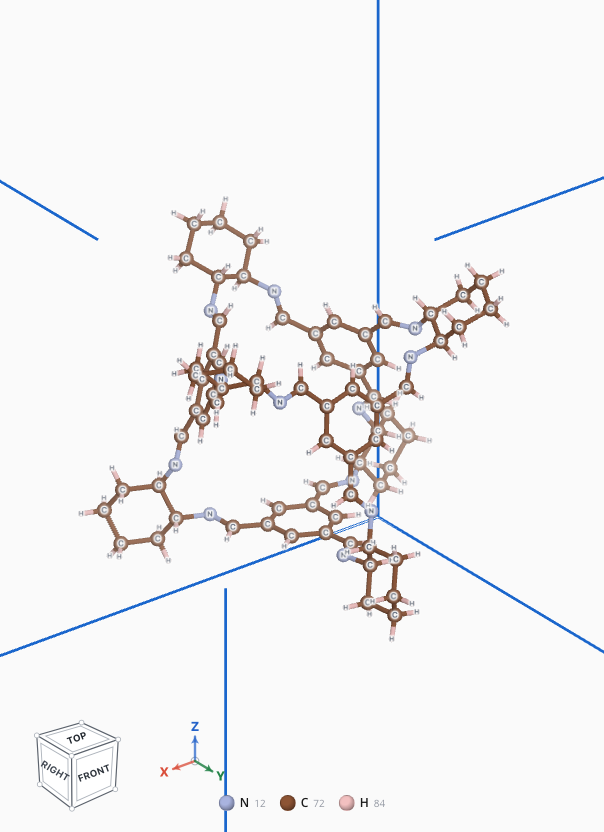
CC3 is a real molecule you can make in a flask: a [4+6] imine cage that Cooper and coworkers build by condensing four triformylbenzene faces with six cyclohexanediamine vertices, closing twelve C=N bonds into a hollow, roughly tetrahedral shell (isolated host formula C₇₂H₈₄N₁₂, 168 atoms). The empty space at its center is a genuine adsorption pocket, and when you flow gas past crystalline CC3 that pocket is selective: at room temperature it takes up CO₂ more than CH₄ more than N₂. That preference is the whole point of a capture material, and it is not obvious — all three guests are small, weakly interacting, and close in size.
The study asks three things, using nothing heavier than a browser tab: whether a fast method reproduces that ordering from the physics alone, whether the cavity itself contributes to binding, and — where a gold-standard coupled-cluster number exists to check against — how far the cheap method lands from it. The sections below answer them one operation at a time.
Defining the binding energy
“How tightly the cage holds a gas” is a comparison: the loaded cage weighed against the empty cage plus the free gas, each at its own relaxed geometry. That is three energies and one subtraction:
Ebind = E(cage + guest) − E(cage) − E(guest)
More negative means more strongly held. Two modeling decisions shape how we measure the three energies, each picking a Tako tool.
- The chemistry holding these guests is physisorption: dispersion and weak electrostatics, with no bonds made or broken. A guest in the cavity is stabilized mostly by the collective van der Waals pull of the organic walls, so the method has to carry dispersion explicitly. In Tako, select GFN2-xTB as the level and D4 as dispersion. That tail is the physics behind the result. We will run Optimization and Single Point with that combination.
- We want the difference between CO₂, CH₄, and N₂ to reflect the site, not three cages each relaxing differently around its guest. So we relax the empty cage once and then hold it rigid while each guest settles inside. → we’ll use the Constraint (freeze) tool.
The plan is a handful of UI operations: open the cage, optimize it, freeze it, dock and relax a guest, then read the Energy tiles and subtract. Run them one at a time, checking each result before moving on.
Step 1 — Open the cage and find the pocket
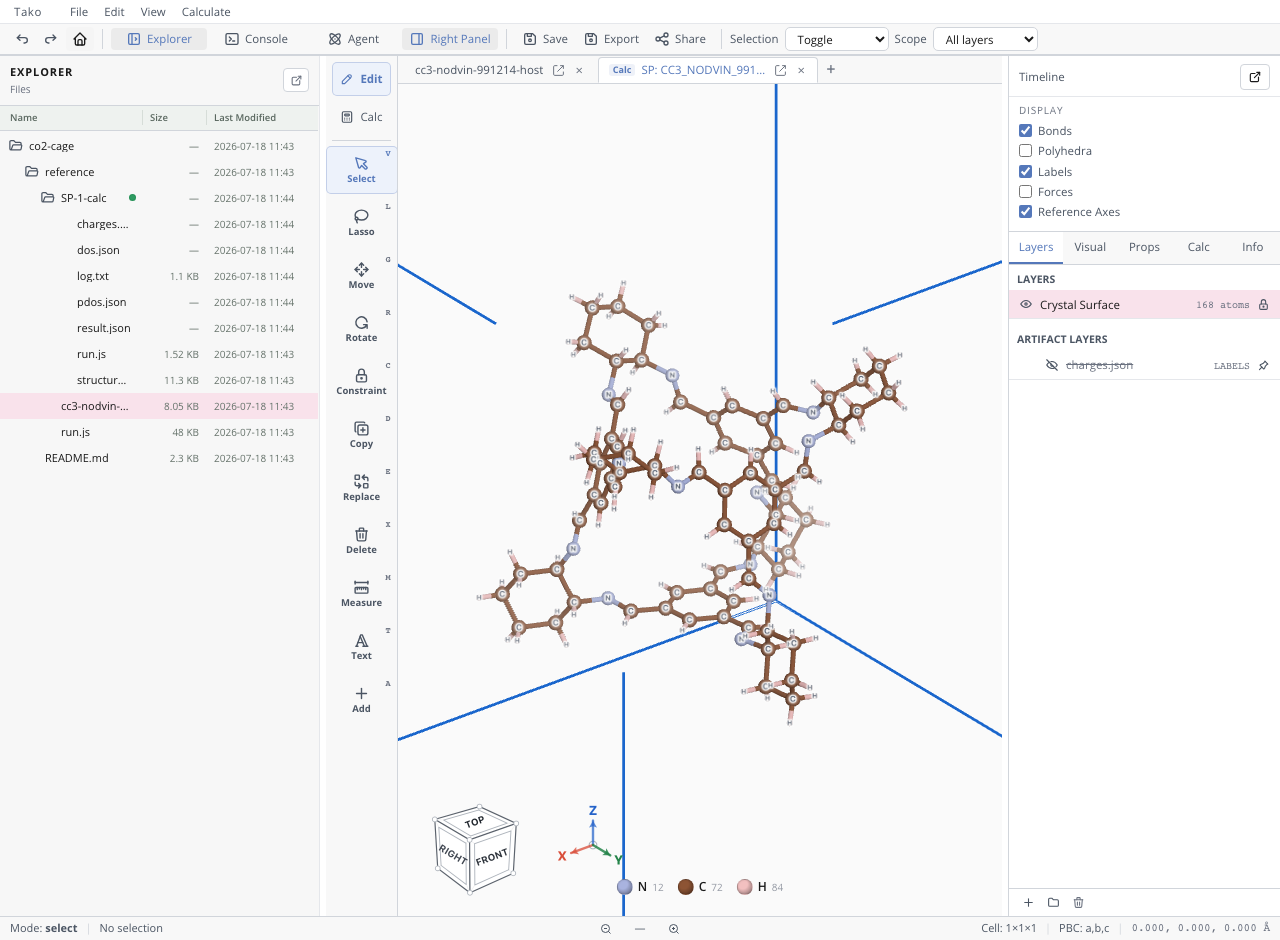
File → Open, and choose cc3-nodvin-991214-host.cif from the demo workspace. The viewport fills with the 168-atom cage, and the Layers panel shows it as a single layer.
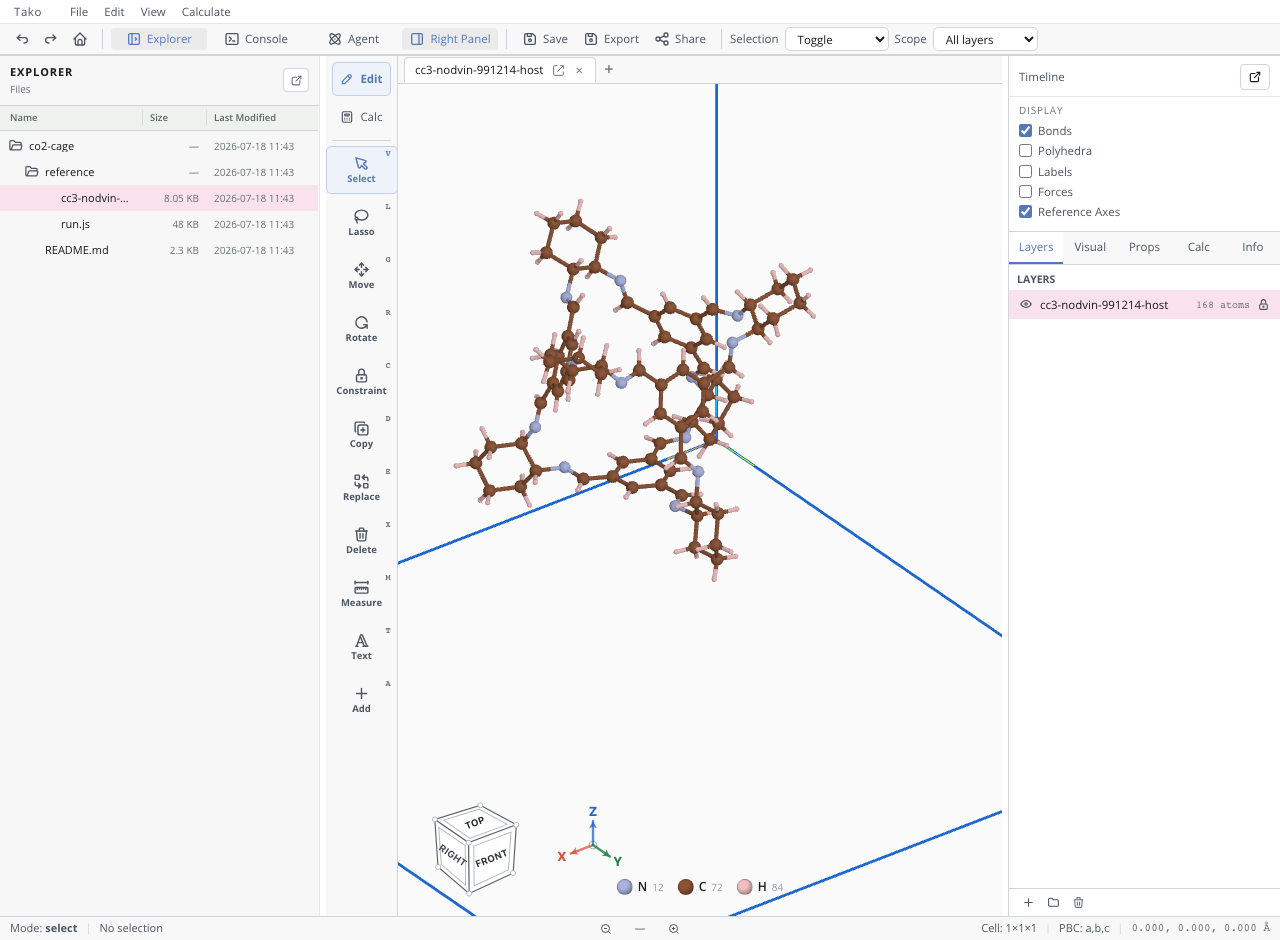
Spin it once. The hollow at the center is the adsorption site — that empty volume is the entire reason this material captures anything. (Tako shows no chemical-formula readout; we know it’s C₇₂H₈₄N₁₂ because that’s the structure we loaded.) This geometry is our starting host.
Step 2 — Relax the empty cage
Open Calc → Optimization. Change Level of theory to GFN2-xTB, then choose D4 in the separate Dispersion selector. Leave the optimizer on BFGS and Cell relaxation collapsed (this is a molecule sitting in a fixed box), and press Start.

The Calc panel takes over: a running status pill, a Steps counter climbing toward its limit, an Fmax that should fall, and a live energy trace bending toward a floor. 168 atoms at GFN2-D4 is real work in a browser, so this one runs for a while — let it settle to completed, then read the Energy tile. That number is E(cage), the first term in our subtraction, and this relaxed shape is the cage we’ll freeze.
Step 3 — Drop a CO₂ into the cavity
Switch to the Add tool, open the SMILES tab, type O=C=O, and press Draw SMILES. A little CO₂ preview appears.
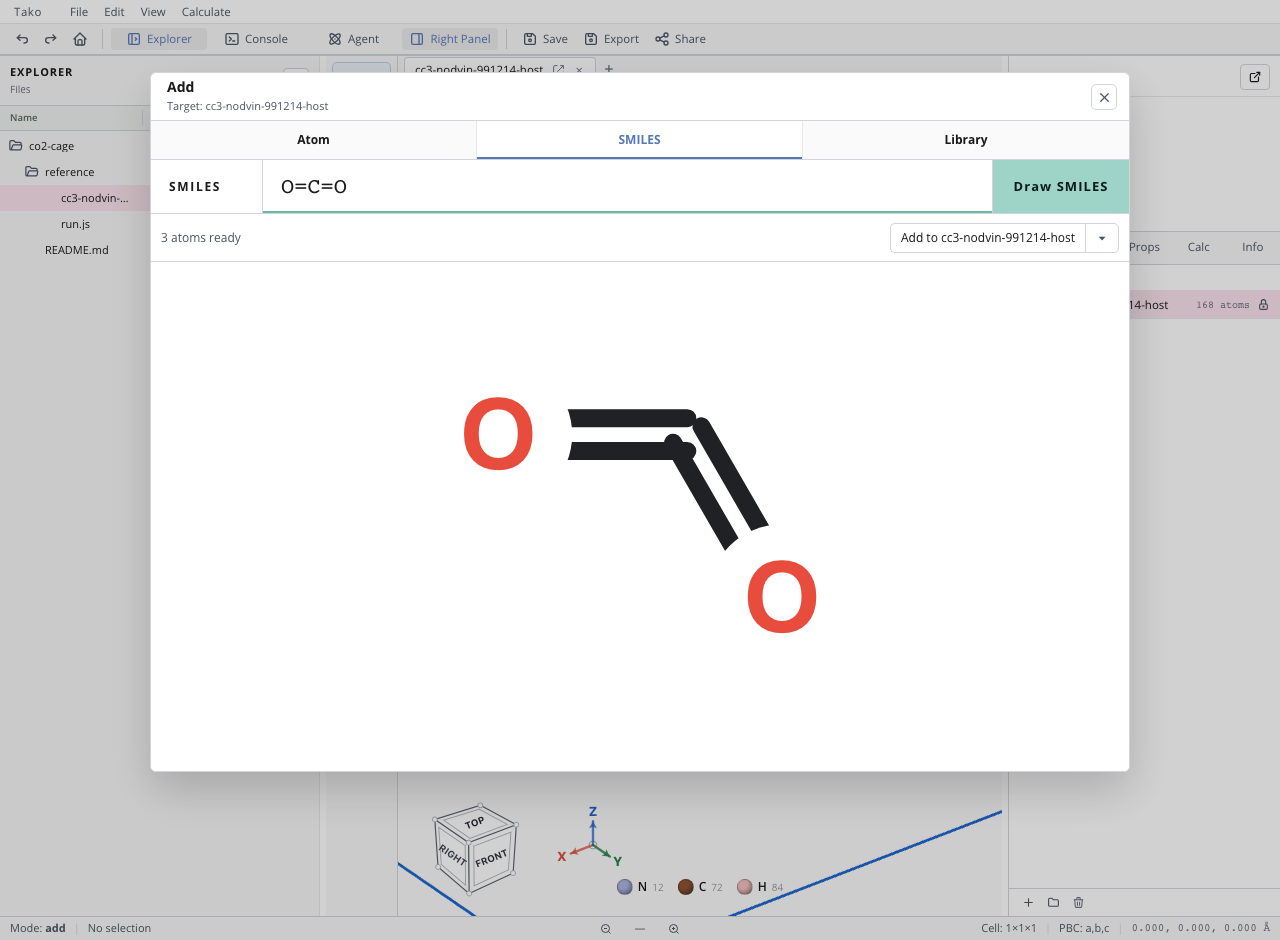
Use the ▾ next to “Add to …” to send it to a New Layer, then click near the center of the cage to drop it in. The guest lands as its own layer — and because Tako computes over every visible layer at once, host and guest are already treated as one system; no merge is required.
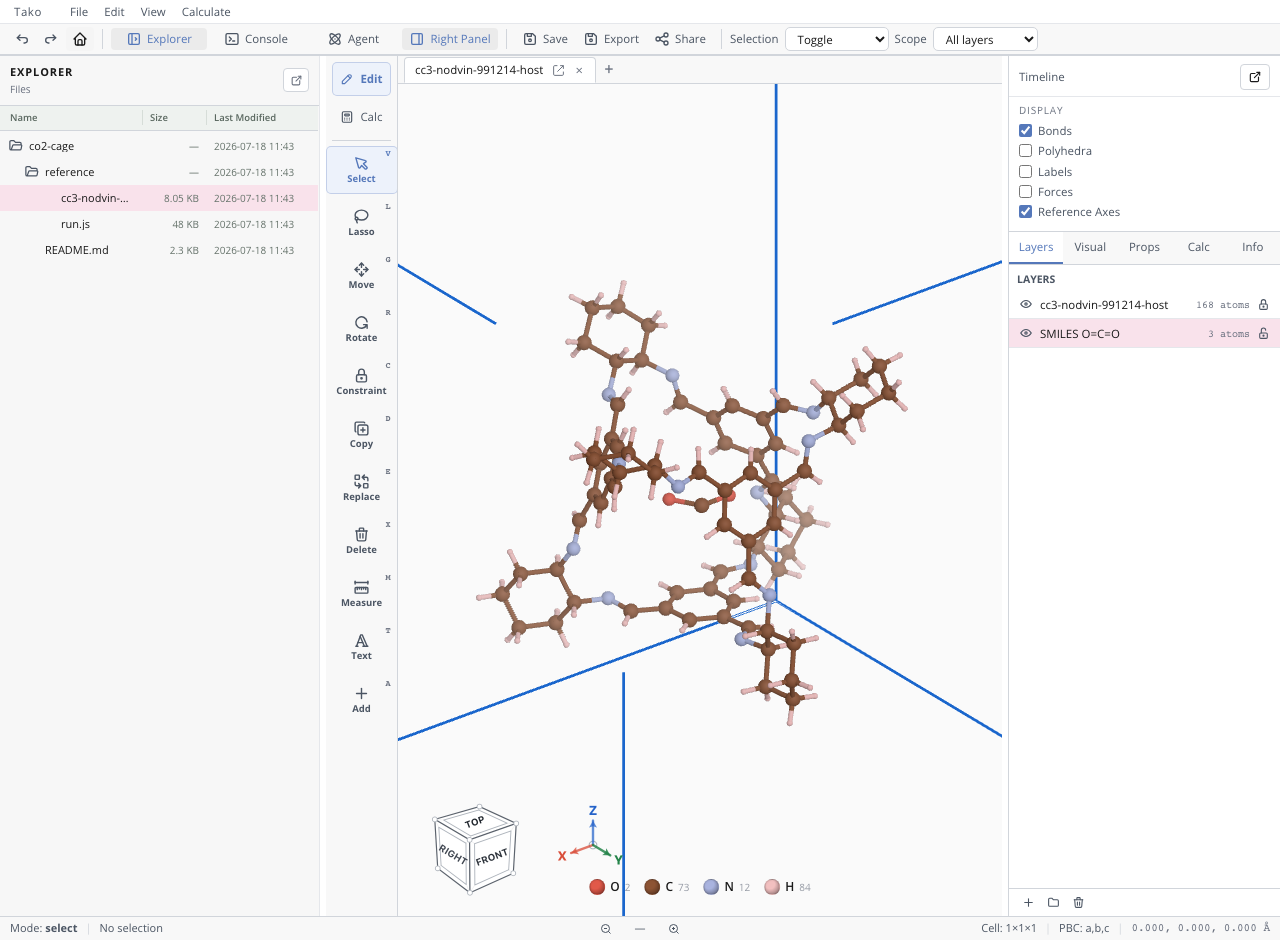
There are now two layers: the 168-atom host and a three-atom guest sitting in the pocket. This is the “loaded cage” whose energy we’re after.
Step 4 — Freeze the cage so only the guest can move
Reach for the Constraint tool and select all 168 cage atoms. In the right panel’s Constraints section, check Fix X, Fix Y, and Fix Z, then press Apply Constraints. Each frozen atom picks up a small red no-entry glyph in the viewport.
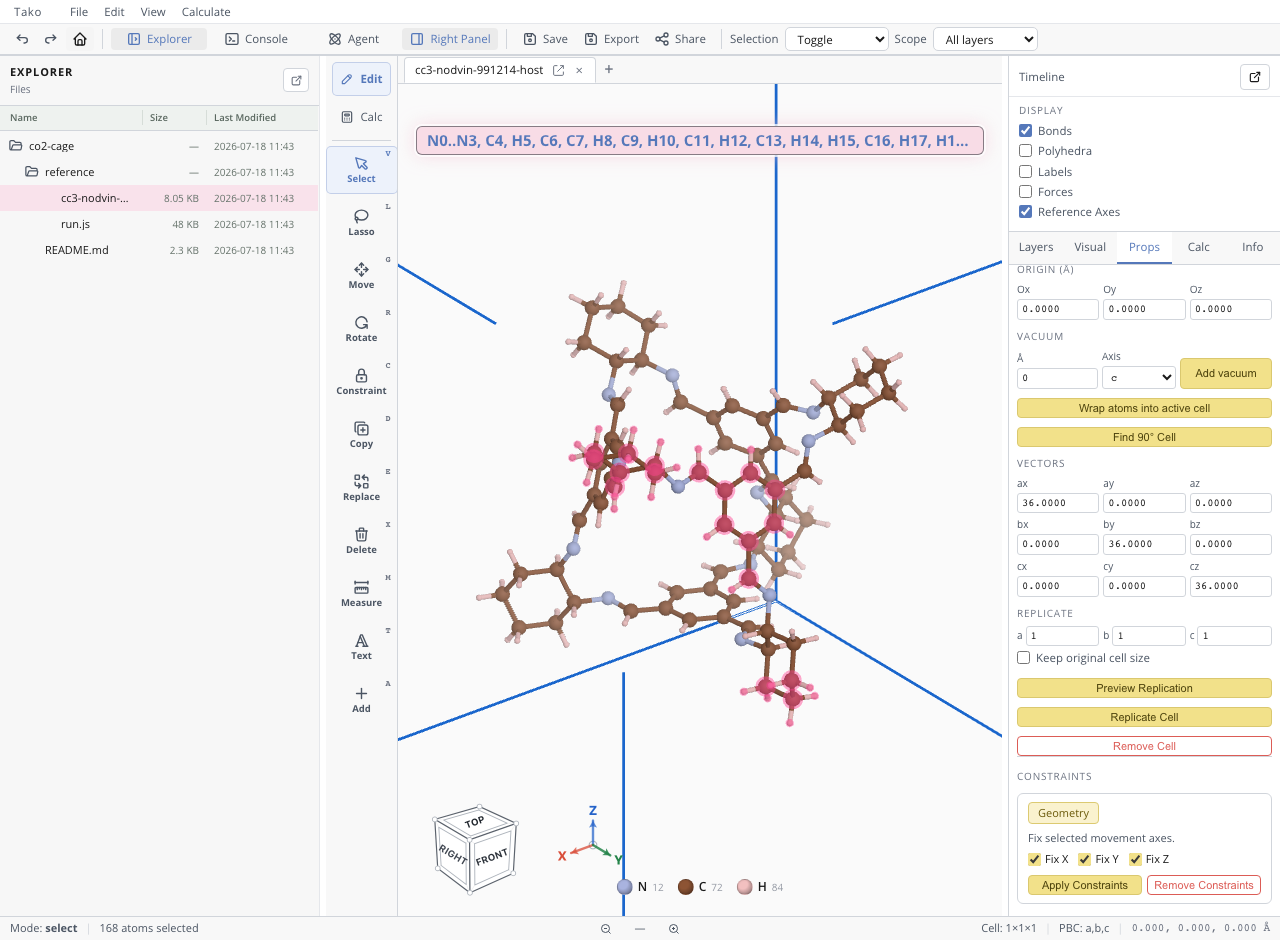
This is the decision that makes the comparison fair. With the cage pinned, the same atoms enter and leave every energy term, and the cage can’t reshape itself differently around each guest — so any difference between CO₂, CH₄, and N₂ comes from the site, not from induced fit. (In this capture we merged host and guest into a single layer first, purely so the 168 cage atoms select as one clean block; the freeze itself works just as well with the layers kept separate.)
Step 5 — Relax the guest and read the binding energy
Open Calc → Optimization again with the frozen cage plus free CO₂, select GFN2-xTB and D4, and Start. Only the guest moves; the cage holds its shape. When it reads completed, the Energy tile is E(cage + CO₂).
One term is left: E(CO₂) for the free molecule. Toggle the cage layer’s eye off in the Layers panel to isolate the guest (or drop the same CO₂ into a fresh tab), run a Single Point with GFN2-xTB and D4, and read its Energy tile. Three numbers, one subtraction:
Ebind = E(cage + CO₂) − E(cage) − E(CO₂)
Do the arithmetic and CO₂ comes out with a negative binding energy — it is bound in the pocket.
Step 6 — Repeat for CH₄, N₂, and for CO₂ outside
The same four operations answer the real question. Dock methane (C) and nitrogen (N#N) exactly the way we did CO₂ — new layer, place at the cavity, freeze the cage, relax the guest, subtract — and place one more CO₂ outside the cage, a few angstroms off the exterior, to ask whether the cavity is what helps or merely being near the organic surface.
Line the four binding energies up and the ordering falls out: CO₂ > CH₄ > N₂, the experimental preference, with the meaningful CH₄ > N₂ step intact — the more polarizable methane held better than nitrogen, exactly what a dispersion-dominated picture predicts. And CO₂ inside beats CO₂ outside, so it really is the pocket doing the stabilizing, not just proximity to the walls.
What the fast method got right, and where it slipped
The ordering is right, and that’s the headline. The instructive part is checking the CO₂ depth against a gold standard. Reported side by side — never folded into our GFN2-D4 numbers — DLPNO-CCSD(T)/CBS binding energies for CC3 are CO₂ −6.95 kcal mol⁻¹ (≈ −29.1 kJ mol⁻¹) and CH₄ −4.14 kcal mol⁻¹ (≈ −17.3 kJ mol⁻¹). GFN2-D4 tracks the CH₄ value well but underbinds CO₂, so it compresses the CO₂/CH₄ gap: it still ranks CO₂ first, but by a smaller margin than coupled cluster says it should be. That’s a concrete caution against reading selectivity straight off a fast number.
Two quick UI checks confirm this is physisorption, not chemistry. Run a Vibration on the bound CO₂: its asymmetric stretch (ν₃) barely shifts from the free molecule — the guest is cradled, not chemically perturbed. (GFN2-D4 places free-CO₂ ν₃ a little above the experimental 2349 cm⁻¹ band; that’s a fixed method offset, unrelated to binding.) And rerun the Single Point with Charges switched on: the Mulliken charge on CO₂ moves by only ~10⁻³ e on binding — the partitioning noise floor, i.e. no charge transfer.
What the number is, and is not
Stated once and meant plainly: what this run produces is a 0 K electronic binding energy at a single fixed-host site. It is not an isotherm, not a Henry coefficient, not an IAST selectivity, and not an association free energy — the run records selectivityNotComputed: true for exactly this reason. It answers “is CO₂ preferred at this pocket, and does the cavity help?” — a fair, useful question — but turning any one row into an uptake ratio would need thermodynamics this model does not carry.
The continuation follows straight from that boundary: sample many orientations and translations of each guest instead of trusting one placement; relax the rigid-host constraint to let the cage flex through its accessible conformers; add zero-point, thermal, and entropic terms to turn the electronic ΔE into a free energy; and build a periodic model of the packed crystal to predict an uptake you could lay next to the measured isotherm. Each step trades speed for a stronger claim. This walkthrough sits deliberately at the fast, cheap end of that ladder.
Sources
- Host structure: the solvent-stripped C₇₂H₈₄N₁₂ CC3-R host residue, CCDC 991214 / CSD refcode NODVIN (Little, Chong, Schmidtmann, Hasell, Cooper), DOI 10.5517/cc128fnf.
- Coupled-cluster benchmark: DLPNO-CCSD(T)/CBS binding energies for CC3 from K. U. Lao, Nanotechnology (2025), DOI 10.1088/1361-6528/ad9b33: CO₂ −6.95 kcal mol⁻¹, CH₄ −4.14 kcal mol⁻¹.