 Tako Docs
Use the Agent
On this page
Ask Tako’s in-browser coding agent to plan, write, execute, and verify a reproducible Tako Script while you retain control over scope, scientific assumptions, and deliverables.
The Agent uses your connected Codex account. The generated script and atomistic calculations run in Tako’s browser workers; model requests necessarily travel through the connected Codex service.
Connect your account
Open Agent from the top toolbar. Choose one supported connection route:
- Sign in with ChatGPT through the device-code flow.
- Load auth.json from the Codex CLI credential file.
- Paste auth.json into the connection form.
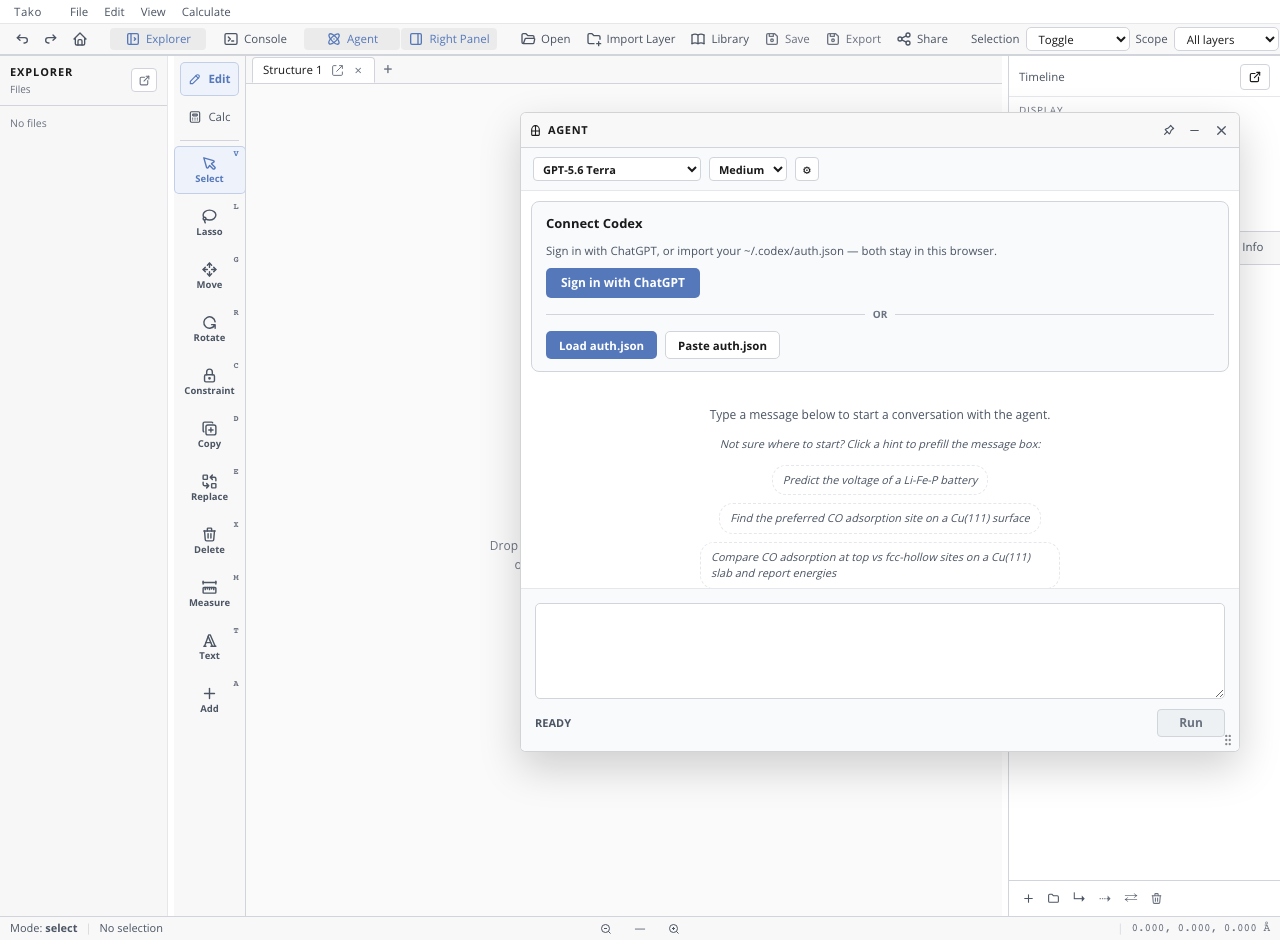
Imported credentials are stored in the current browser profile. Treat them as sensitive: do not include them in screenshots, workspace exports, scripts, or reports. Clear the credential from Agent settings on a shared machine.
Start a task
Write a prompt that specifies:
- The scientific question.
- Inputs or structures to use.
- Required method or the criteria for choosing one.
- Validation gates.
- Exact deliverable paths.
- Claims that must not be made.
Example:
Map a coarse water PES over O–H distance and H–O–H angle with GFN2. Write
reference/run.js,output/summary.json, a contour SVG, an interactive Plotly surface, andanalysis.md. Report this as a demonstration, not a transition-state calculation.
Choose model/reasoning effort, then click Run. Higher effort can help with ambiguous multi-stage design.
Read the plan before execution
The first accepted turn must write a plan containing ## Deliverables and a checklist. Review it for scope, method, validation, and filenames. A well-formed plan can still contain a scientifically poor choice; steer before expensive calculations begin.
The Agent verifies declared deliverable paths are non-empty before it can report success. This checks existence, not scientific validity.
Steer, stop, and resume
While a run is active, the input becomes Steer. Send corrections such as a missing comparison site, wrong model domain, or stronger convergence gate. Steering messages are consumed at turn boundaries and should be reflected in the plan.
Use Stop when continuing would waste resources or produce invalid work. A stopped conversation remains inspectable. Use New only when a clean context is preferable to a follow-up.
Inspect the deliverables
Do not accept only the final chat message. Decide whether the run is reproducible and scientifically supportable, not merely complete according to its file-existence gate.
Review order
- Read the original request and final
plan.mdfor declared scope and checklist state. - Confirm every deliverable exists and has the intended role.
- Read
reference/run.jscompletely as the executable method. - Verify input provenance, atom counts, cells, charges, and constraints.
- Inspect each calculation log and quality gate, including convergence diagnostics.
- Recalculate headline values from
output/summary.jsonand supporting tables. - Compare plots with their source data and labels.
- Read claims and limitations in
analysis.md.
Audit table
| Layer | Evidence | Reject when |
|---|---|---|
| Scope | Request and plan agree | Steering/deliverables were ignored |
| API | Only documented tako.* calls | Invented helper or hidden manual result |
| Inputs | Source and transformations recorded | Hand sketch presented as validated structure |
| Method | Chemistry/property is in domain | Convenience model chosen without justification |
| Execution | Logs and result objects complete | Error/unconverged stage reused |
| Calculation | Explicit convergence/sanity gates | Plausible number bypasses failed gate |
| Analysis | Formula, units, signs, normalization | Headline cannot be rederived |
| Plot | Source table and axes/units match | Cropped/mislabeled or hard-coded values |
| Claims | Evidence level and exclusions explicit | Screening result presented as experimental fact |
Verify independently
Where risk warrants, rerun the script, alter one parameter to test sensitivity, compare against a known small case, or validate with another method. Agent self-review is useful but not independent evidence.
Context, compaction, and history
The context meter reports active usage for the selected model. Compaction preserves the original request, recent turns, and a history bridge that points back to plan/log/files. The plan and workspace artifacts—not conversational memory—should remain the durable state.
Terminal runs are stored in a capped local run history with prompt, model, effort, status, usage, duration, summary, files, and log tail. Export history when you need an audit record; it is not a substitute for the scientific workspace.
Privacy boundary
Agent conversation/context leaves the browser through your Codex connection. Tako Script and calculation execution remain client-side, apart from downloading static runtimes/model weights. Review what structures, reports, screenshots, or files are included in prompts/tool context before using sensitive data.
Troubleshooting
| Symptom | Likely cause | Fix |
|---|---|---|
| Plan rejected | Missing literal deliverables/checklist structure | Ask Agent to use the displayed valid plan format |
| Authentication expires | Refresh/import policy or token expired | Reconnect; review auto-refresh setting |
| Repeated rate limit | Account/backend limits | Wait or reduce concurrent/repeated work |
| Image not received | Selected model lacks image input | Choose compatible model or describe/provide text data |
| Generated path is doubled | Script included run-folder prefix | Use paths relative to the run workspace |
| Deliverables exist but result is wrong | Existence gate is not scientific validation | Inspect method, logs, convergence, and claims |
| Missing output | Declared deliverable was never produced | Reopen the plan and request the exact path |
| Script and report disagree | analysis.md restates rather than derives from run.js/results | Treat executable and raw artifacts as evidence; correct the report |
| Result uses a literature constant as the computed value | Benchmark/context value substituted for the actual Tako result | Separate benchmark/context from the Tako result |
| Convergence fields omitted | Diagnostic extraction missing from run.js | Add diagnostic extraction and rerun |
| Final answer overstates evidence | Screening/demonstration result presented as fact | Rewrite supported/unsupported conclusions explicitly |