 Tako Docs
Thymol and Carvacrol in Beta-Cyclodextrin
On this page
The host, the guests, and the near-tie
Beta-cyclodextrin is a ring of seven sugar units — a shallow, cone-shaped torus with a water-shy hollow down the middle. That hollow is the interesting part. Drop a small, greasy molecule into water alongside beta-cyclodextrin and it will often slip inside the cavity, trading unfavourable contact with water for a snug fit against the ring’s interior. The included guest dissolves more readily, resists evaporation and oxidation, and can be released on cue. This is how a bitter drug is made palatable, how a volatile flavour is locked into a powder, and how a poorly soluble active is brought into solution — one report has hydroxypropyl-beta-cyclodextrin lifting a flavone’s solubility roughly 360-fold on complexation (ACS Omega 2025, DOI 10.1021/acsomega.5c08909).
So the cavity is a container. The question a formulator asks is how tightly it holds a given guest and, when choosing between candidates, which one it prefers. The test pair here is deliberately hard. Thymol and carvacrol are the aromatic scent-and-antiseptic molecules of thyme and oregano. They are also constitutional isomers: identical formula (C₁₀H₁₄O), same phenol ring, same isopropyl and methyl groups — only the positions of the hydroxyl and the isopropyl are swapped around the ring. Any preference the cavity shows is between two molecules of the same size, shape, and chemistry, so it will be subtle. This is exactly the kind of near-tie where a single snapshot could point to a winner that isn’t there.
Measuring the inclusion energy
The quantity we want is an inclusion energy: how much lower the energy of the whole system is with the guest tucked in the cavity than with the two apart. That is a difference of three energies — the complex, the empty host, and the free guest — all computed with the same method, here the semi-empirical GFN2 tight-binding model with D4 dispersion (dispersion is what makes a hydrophobic cavity grip). In the script it is a single line, and that line is the measurement:
const bindingEv = point.energyEv - hostEnergyEv - freeGuestEnergyEv;A negative number means inclusion is downhill — the guest would rather be inside.
One modeling choice shapes everything downstream: we hold the 147-atom host rigid. Before docking anything we freeze every host atom in place and let only the guest relax against it.
tako.structure.fix(complex, hostIndices); // host atoms 0..146 frozen; guest mobileFreezing the host is what makes the comparison clean. Because the identical 147 host coordinates appear in the empty-host energy and inside every complex, the host’s own contribution cancels exactly in the subtraction — host deformation is zero by construction. What survives is the part we care about: how the guest fits and how much the guest itself has to distort to do so. The cost is real and named below: a frozen host cannot reshape itself around each guest, so we are measuring the grip of a fixed pocket, not one that reshapes around its occupant.
Sampling multiple docking poses
A near-tie is fragile for a specific reason. Docking a molecule means choosing a starting orientation, and a single starting orientation lands in a single nearby minimum. For two isomers this close, the “winner” could be an artifact of which way each guest was pointed going in. One pose cannot order two near-degenerate molecules reliably.
So we do not trust one pose. Each guest is dropped into the cavity from four scripted orientations and each is relaxed independently:
const POSE_ORIENTATIONS = [
  { name: 'identity',      apply: (s) => s },                    // as loaded
  { name: 'flip-x-180',    apply: (s) => rotateX(s, Math.PI) },  // head-over-tail
  { name: 'zrot-plus-90',  apply: (s) => rotateZ(s,  Math.PI/2) },
  { name: 'zrot-minus-90', apply: (s) => rotateZ(s, -Math.PI/2) },
];
Sampling multiple entry poses is the scientific core of the method, not a formality. It turns a single number into a spread: re-orient the same guest, relax again, and measure how far the binding energy wanders. The spread sets the noise floor. We accept a preference for one isomer over the other only if the gap between them exceeds the spread from re-pointing a single guest, and we require at least two converged poses per guest before the spread counts as a measurement rather than an accident. A gap smaller than a guest’s own pose spread is noise, not a preference.
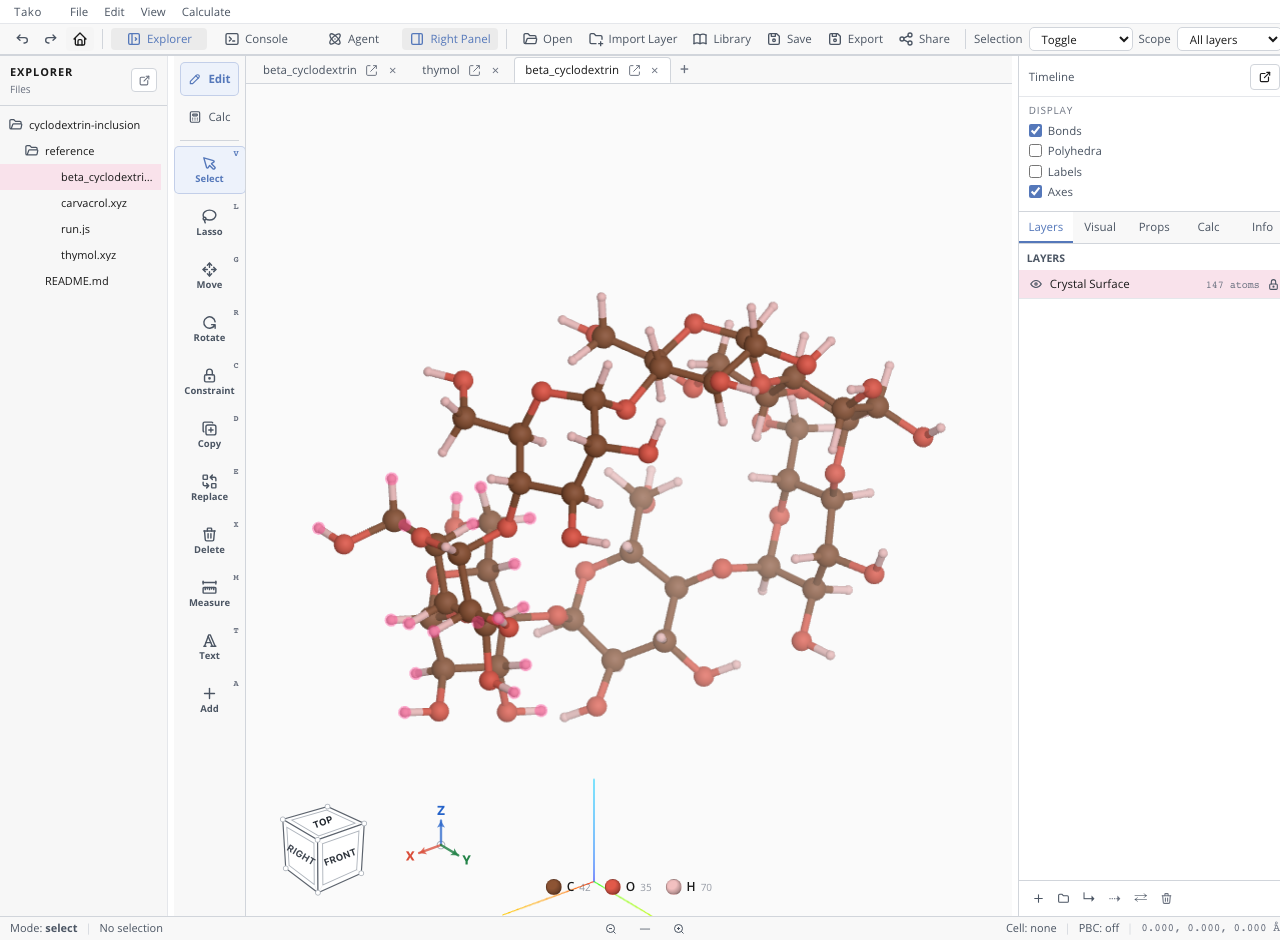
This is the 147-atom host cavity alone — the pocket we dock into. Inclusion is read off the relaxed complex after a run.
What the cavity does with each guest
Two findings hold robustly, and one, by design, does not.
Both guests bind, and by a physically sensible amount. Every accepted pose comes out favourable — the guests prefer the cavity to open space — and the magnitudes land in the range GFN2-flavoured methods give for beta-cyclodextrin inclusion, roughly −40 to −90 kJ/mol. This is the boring result you want first: the cavity behaves like a hydrophobic pocket should, the dispersion attraction of the interior is doing recognizable work, and neither isomer is rattling around loose or clashing its way to a nonsense energy. Both molecules settle into the hollow rather than perching on the rim.
Which isomer wins may be too close to call. Thymol and carvacrol come out neck and neck, exactly as their near-identical structures predict. Whether the run reports a winner depends entirely on the test we set up in advance: the thymol–carvacrol gap has to exceed the larger of the two pose spreads, with two or more converged poses backing each guest. When the gap is smaller than the noise from simply re-orienting a guest, the honest headline is “comparable, not resolved at this resolution” — and that restraint is a result, not a failure. The short contact and centroid-offset distances the run reports confirm the guest is sitting deep in the cavity rather than on the surface, though the relaxed complex is worth a look to confirm encapsulation.
What this number is, and what it is not
One caveat governs how far any of this travels, and it is worth stating squarely. This is a rigid-host, gas-phase, 0 K electronic energy. The real quantity a formulator cares about is an aqueous binding free energy at room temperature, which experiment puts at roughly −10 to −30 kJ/mol for this class of complex. Our numbers sit about an order of magnitude deeper. That gap is expected, not a bug: we have left out the water that the guest must push aside, the entropy paid on binding, the thermal and zero-point motion, and — because the host is frozen — the induced fit of a pocket reshaping around its guest. So the inclusion energy here is a ranking tool for poses under one fixed pocket. It is not an association constant, and pushing it through ΔG° = −RT ln K does not yield a valid solubility number. It tells us both guests bind and roughly how strongly the cavity grips; it does not tell us the shelf-solubility of a thyme extract.
From a ranking to an affinity
The natural next steps all point at the assumptions we made on purpose. Let the host relax together with the guest, and induced fit — which can differ between two isomers — becomes part of the answer instead of a cancelled term; that alone might break the current tie. Sample the isopropyl rotamers, since a single frozen conformer under-explores how each guest actually sits. Then add explicit solvent and a proper standard state and compute free energies rather than one electronic minimum, and the result stops being a pose ranking and starts being an affinity you could compare to a measured association constant. Each of those is a real step up in cost, and each is the right one to take before turning “comparable” into a formulation decision.
Sources
The host is beta-cyclodextrin (C₄₂H₇₀O₃₅, 147
atoms), taken from the RCSB Chemical Component Dictionary entry BCD as
ideal-coordinate geometry and held rigid — a real cyclodextrin geometry used as a
fixed pocket, not a conformation lifted from a specific diffraction experiment.
The guests are thymol (2-isopropyl-5-methylphenol) and carvacrol
(5-isopropyl-2-methylphenol), each C₁₀H₁₄O; a full
publication record would pin their exact source identifiers and retrieval dates.
GFN2-xTB is used here on the strength of published precedent for thymol/carvacrol
binding in beta-cyclodextrin
(DOI 10.1007/s10847-024-01249-x) —
method precedent, not a coupled-cluster benchmark. The 360-fold solubility figure
(DOI 10.1021/acsomega.5c08909) is
scale-setting context for why inclusion matters, drawn from a different guest and
host derivative; it is motivation, not evidence for these two molecules.