 Tako Docs
Calculate Crystal Phonons
On this page
The Phonon command builds finite-displacement force constants for a periodic crystal, evaluates modes at Γ, creates the current Γ-frequency histogram, and attempts a phonon band along a crystallographic path. This page describes the visible controls and resulting files. The direct method, dynamical matrix, acoustic sum rule, and convergence requirements are developed in Crystal Phonons and Lattice Dynamics; JavaScript belongs in Crystal Phonons with Tako Script.
Periodic state before setup
Activate a relaxed periodic structure with a valid three-dimensional cell. The atomic positions and cell should be stationary under the same calculator that will supply displaced forces. Confirm:
- periodic boundary conditions and the cell are intentional;
- atomic forces and cell stress satisfy the convergence required by the study;
- the calculator has been validated for the material and for displaced configurations;
- any constraints or isotope masses are recorded separately, because the current periodic primitive-cell reconstruction does not transfer them into the phonon calculation;
- charge, spin, dispersion, and calculator variant match the preceding relaxation where they apply.
A nonperiodic structure can open the same command, but Phonon Setup displays Band paths need PBC and offers Add minimal PBC cell. A generated bounding cell does not create lattice periodicity; use Calculate Molecular Vibrations for an isolated system.
Open Phonon Setup
In the left tool rail, choose Calc, then Phonon. Tako opens Phonon Setup for the active structure. The dialog title deliberately uses the compact label “Phono”; use that exact title when locating it.
The upper calculator region is shared with other calculation dialogs. The current default is nequix PFT, whose level identifier is nequix-phono and whose default supercell is 3×3×3. Selecting another model changes an unedited supercell default to 2×2×2. Model selection, cache status, and GFN2 electronic controls are documented once in Choose a Calculator.
Supercell, displacement, and band sampling
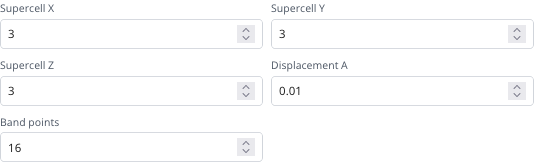
The Phonon region contains five numerical controls.
| Control | Current state for nequix PFT | Operation |
|---|---|---|
| Supercell X | 3 | Repeats the standardized primitive cell along its first lattice vector. |
| Supercell Y | 3 | Repeats along the second primitive lattice vector. |
| Supercell Z | 3 | Repeats along the third primitive lattice vector. |
| Displacement A | 0.01 | Sets the positive Cartesian displacement magnitude in ångström; the backend evaluates both signs. |
| Band points | 16 | Sets interpolation points per reciprocal-path segment; normalized to a positive integer and capped at 64. |
The repeat values are normalized to positive integers and clamped to 1–6 by the worker. The displayed defaults are starting values, not converged parameters. Supercell convergence changes the real-space range represented by the force constants. Band points only changes how densely those same force constants are evaluated along the chosen path; increasing it cannot repair an undersized supercell.
Tako standardizes a valid periodic input to a SeekPath primitive cell before applying these repeats. A 3×3×3 setting therefore repeats that standardized primitive cell, not necessarily the conventional cell visible before the run. The console reports the input-to-primitive atom-count change when a reduction occurs. This reconstruction currently retains elements, positions, and lattice but not input constraints or custom isotope masses; every reconstructed primitive atom is active with its default elemental mass.
Generate or enter the band path

Open Band path below the numerical fields. The expanded region contains Generate SeekPath and Path string.
For a periodic cell, press Generate SeekPath to derive a recommended high-symmetry path from the current structure. While it runs, the button reads Generating…. On success, the generated labels appear in Path string together with a status message. Read the string before starting the calculation; it applies to the standardized primitive reciprocal basis.
You may enter a custom string such as G X W L G. Editing the field clears the prior generation status. Leave it empty if the worker should derive the path during execution. An invalid label or incompatible path can prevent only the band stage: Γ modes and the Γ histogram may already be available when the worker logs that band generation failed.
The path samples selected reciprocal-space lines, not the entire Brillouin zone. A smooth path with no negative branch does not cover general q, so it is not a complete stability search.
Start and follow the stages
Before pressing Start, reread the selected model, three repeats, displacement, band-point count, and path. The dialog closes and the console reports three periodic stages:
- Calculating periodic finite displacements;
- Building phonon DOS;
- Building phonon band.
The first stage contains the expensive calculator work. The later stages reuse the conditioned force constants. Partial results are published between stages, so a calculation folder can show available Γ data while the band is still pending.
Completion means the worker returned, not that the structure is dynamically stable or supercell-converged. Read the console for primitive-cell conversion, model-loading failures, invalid paths, or a band stage that was omitted.
Explorer files and viewers
The calculation folder creates three pending output entries. Their final availability is conditional:
| File | Availability | Numerical content and viewer |
|---|---|---|
phonon.json | finite-displacement stage succeeded | Γ signed frequencies, complex frequency components, harmonic energies, zero-point energy, and Cartesian mode vectors for the active standardized primitive cell |
phonon_dos.json | Γ histogram stage succeeded | Positive Γ energies at histogram bin centers and their counts; opens the Phonon DOS viewer |
phonon_band.json | reciprocal path and band evaluation succeeded | Bravais lattice, path source/string, q points, frequencies in cm⁻¹, and path/label metadata; opens the Phonon band viewer |
The current DOS file is a Γ-only histogram, not a q-mesh-integrated crystal density of states. It is not suitable for phonon thermodynamics or for Brillouin-zone-sampled analysis.
The band JSON stores frequencies in cm⁻¹. The Phonon band viewer converts them to THz and labels its vertical axis Frequency (THz). Preserve the JSON for quantitative reporting and state the unit if a value is read from the viewer.
The public folder does not expose displaced supercells, image-resolved force constants, or a restart cache. Starting the command again repeats the displaced force evaluations.
Interpret the band without overclaiming
For a complete unconstrained primitive basis, three acoustic branches should approach zero at Γ. Tako conditions the force constants with symmetry and the acoustic sum rule, so near-zero acoustic values are expected but do not independently validate raw force quality.
Investigate every materially negative branch:
- locate its q point and path segment;
- verify the preceding atomic/cell relaxation and residual stress;
- repeat at another displacement;
- compare a larger, physically motivated supercell;
- test calculator transferability on the distorted mode;
- account for missing non-analytic LO–TO correction in polar crystals.
A persistent negative mode can support a harmonic instability under the selected model. A path-only calculation cannot establish stability away from the plotted lines. State the actual reciprocal-space coverage.
Failure and sensitivity patterns
| Visible result | Inspect | Corrective action |
|---|---|---|
| Band paths need PBC | structure periodicity and cell | Use a genuine periodic crystal; adding a cell to an isolated molecule does not create periodicity. |
| Run becomes too large | standardized primitive atom count and supercell volume | Use a diagnostic smaller cell only as part of a stated convergence series; choose anisotropic repeats when physically justified. |
| Acoustic branches miss zero substantially | relaxation, displacement, force noise, or an unsuitable structure model | Re-relax and test displacement and supercell; input constraints do not carry into the periodic primitive reconstruction. |
| Negative branches change with repeats | real-space truncation | Continue supercell convergence before assigning an instability. |
phonon.json exists but phonon_band.json does not | console path/band error | Regenerate or correct Path string; Γ results may remain valid. |
| Path labels differ from a reference | primitive/conventional setting and symmetry | Compare standardized cells and use the correct reciprocal-basis labels. |
| DOS appears sparse | Γ-only histogram semantics | Do not smooth it into a crystal DOS; obtain an independent q-mesh DOS when required. |
| Polar optical modes lack expected splitting | missing Born-charge/dielectric NAC | Use an NAC-capable reference workflow and state Tako’s boundary. |
Record the input and standardized cell identity, model, relaxation evidence, constraints, repeats, displacement, path source/string, band points, units, and all convergence comparisons. Continue with Crystal Phonons and Lattice Dynamics for the scientific interpretation of each check.